RESILAND Uzbekistan: A New Digital Platform to Transform the Nursery Sector
As Uzbekistan advances its commitments under the Bonn Challenge and its Nationally Determined Contribution (NDC) to restore 500,000 hectares of degraded land by 2030, the availability of high-quality planting material has emerged as a critical constraint to large-scale forest landscape restoration. To address this challenge, the RESILAND Uzbekistan Project has developed and launched a dedicated nursery information platform, available in four languages (Uzbek, Russian, English, and Turkish): www.uzbeknursery.com.
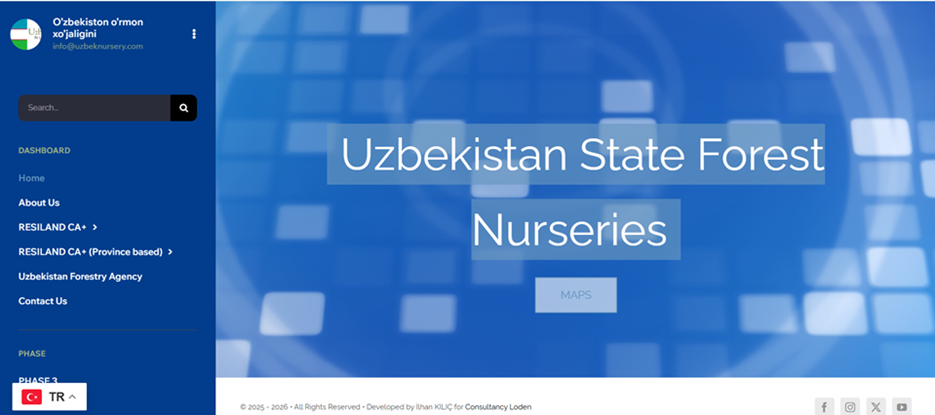
The platform represents a first-of-its-kind solution for Uzbekistan’s forestry sector. Drawing on the extensive experience of Turkey — widely recognized for its advanced nursery production systems and large-scale afforestation achievements — the platform was developed through a structured South–South knowledge exchange between Turkish forestry specialists and the RESILAND project team.
This collaboration enabled the adaptation of international best practices to Uzbekistan’s specific ecological, climatic, and institutional conditions across six project corridors in the Jizzakh, Namangan, Kashkadarya, Samarkand, Syrdarya, and Surkhandarya regions, with plans for future expansion to additional regions.
The platform is available in four languages — Uzbek, Russian, English, and Turkish — ensuring accessibility for a broad range of users, including national forestry professionals, regional practitioners, international partners, and researchers.
Site Selection: The Foundation of Successful Restoration
Among all phases of nursery establishment, site identification and selection constitute the most critical decisions. Errors at this stage — whether related to soil conditions, water availability, topography, or proximity to restoration areas — are difficult and costly to correct once infrastructure is in place.
The platform therefore places site suitability assessment at its core, integrating the following key decision-support functions:
- Soil and water quality analysis: Provides access to data on soil texture, pH, fertility, and water availability, enabling evidence-based site selection aligned with the ecological requirements of target species.
- Field measurement and yield estimation: Includes tools for recording and analyzing field data, supporting projections of seedling production capacity and expected output at individual nursery sites.
- Species and seedling inventory management: Enables stakeholders to identify and monitor the availability of tree and shrub species, facilitating coordinated supply planning across the six project corridors.
- Stakeholder connectivity: Serves as a shared platform linking nursery managers, forestry enterprises, regional coordinators, and project management, thereby streamlining communication and reducing duplication across Uzbekistan’s 79 state forestry enterprises.
Strategic Significance
The launch of the platform directly supports implementation of Presidential Decree No. PQ-140 (March 27, 2024), which mandates agro-technical landscape restoration measures across 253,620 hectares of State Forest Fund land.
With nine nursery sites currently under design across six regions — under the technical guidance of international nursery consultant Ismail Belen — the platform will serve as a core operational tool for seedling production planning, quality assurance, and supply chain coordination across the program.
The integration of Turkish expertise is particularly noteworthy given Turkey’s track record as a global leader in large-scale nursery-based reforestation, producing billions of seedlings annually through a network of advanced nursery facilities. The knowledge transferred through this partnership — including production planning, substrate management, root quality standards, and climate-adapted species selection — is directly applicable to Uzbekistan’s dry montane and semi-arid restoration contexts.
For more information, to explore the platform, or to engage with the RESILAND Uzbekistan nursery program, please visit: www.uzbeknursery.com
—————————————————————
The Uzbekistan Resilient Landscape Restoration Project (RESILAND Uzbekistan) is part of the World Bank’s RESILAND CA+ program, aimed at strengthening landscape resilience across Central Asian countries. Similar national and regional activities are also being implemented in Kyrgyzstan and Uzbekistan.
RESILAND Uzbekistan is implemented by the Agency for Afforestation, Expansion of Green Areas, and Combating Desertification under the Ministry of Ecology, Environmental Protection, and Climate Change of the Republic of Uzbekistan, with financial support from the World Bank, PROGREEN, and KWPF.
The Regional Environmental Centre for Central Asia (CAREC) implements the regional component of the Uzbekistan Resilient Landscape Restoration Project.
Contact information:
Asferachew Abate – Senior Environmental Specialist at The World Bank
Dildora Aralova – Environmental safety specialist, the Agency for Afforestation, Expansion of Green Areas, and Combating Desertification under the Ministry of Ecology, Environmental Protection, and Climate Change of the Republic of Uzbekistan
Azamat Kauazov – Deputy Team Leader of Uzbekistan Resilient Landscape Restoration project: regional component, CAREC
