
Uzbekistan Resilient Landscapes Restoration Project (RESILAND CA)
First Assessment &Feasibility Reports of Nine Nurseries
Phase 4: First Assessment &Feasibility Report
Design, Upgrading, and Preparation of Nine (9) Forestry Nurseries
Uzbekistan Resilient Landscapes Restoration Project (RESILAND CA)
Report Title:
First Assessment &Feasibility Reports of Nine Nurseries
Prepared by:
İsmail Belen
International Consultant – Forestry Nursery Design and Preparation
Date: 8 March 2026
İçindekiler Tablosu
Purpose and Scope of the Report 3
1. Introduction, Context and Policy Framework 5
1.1 Strategic Positioning of the Nine Nurseries within RESILAND CA+ 5
1.2 Alignment with the Uzbekistan–2030 Strategy and National Environmental Priorities 6
2. Current Status of Forest Resources and Forest Management in Uzbekistan 6
2.1 National Forest Resource Data and Forest Fund Mapping 7
2.2.Strategic Implications for the RESILAND CA+ Nursery System 10
2.2.1.Implications for the RESILAND CA+ Nursery System 11
2.2.2. Carbon, Climate, and Investment Dimensions 12
2.2.3. Land Availability for the National Seedling Target 13
2.2.4. Technical and Ecological Considerations for Nursery Production 13
2.2.5. Strategic Role of the Nine Nurseries 14
3. Individual Nursery Assessments and Technical Feasibility Analysis 15
3.1 G’allaorol State Forestry Enterprises – Qoravultepa Forest Section Nursery (Jizzakh Region) 15
3.2 Kitob State Forestry Enterprises Nursery (Kashkadarya Region) 17
3.3 Sho‘rtan State Forestry Enterprises Nursery (Kashkadarya Region) 19
3.4 Namangan Central State Forestry Enterprises Nursery (Namangan Region) 21
3.5 O‘rta Orol State Forestry Enterprises Nursery (Namangan Region) 23
3.6 Dargom Specialized State Forest Seedling Production Enterprise Nursery (Samarkand Region) 25
3.7 Samarkand Central State Forestry – Pastdargʻom Forest Section Nursery (Samarkand Region) 27
3.8 Surkhandarya State Forestry Enterprises Nursery (Surkhandarya Region) 30
3.9 Uzun State Forestry Enterprises Nursery (Surkhandarya Region) 32
4. Overall Assessment of All Nurseries 34
Purpose and Scope of the Report
This report forms an integral component of the consultancy services implemented under Contract No. LRP/IC/08, titled “International Consultant to Provide Technical Expertise for the Design, Upgrading, and Preparation of Nine (9) Forestry Nurseries.” The consultancy aims to strengthen Uzbekistan’s national nursery system by establishing a technically robust, regionally distributed, and climate-resilient production infrastructure capable of supporting large-scale landscape restoration, afforestation, and ecosystem rehabilitation programs.
Within this framework, Mr. İsmail Belen, International Consultant, conducted a series of field missions during February 2026 to the nursery locations under the following State Forestry Enterprises:
- Sho‘rtan State Forestry – Kashkadarya Region
- Kitob State Forestry – Kashkadarya Region
- Samarkand Central State Forestry – Samarkand Region
- Darg‘om State Forestry – Samarkand Region
- G’allaorol O’rman mudurligi, Qoravultepa o’rman bo’limi– Jizzakh Region
- Namangan Central State Forestry – Namangan Region
- O‘rta Orol State Forestry – Namangan Region
- Surkhandarya State Forestry – Surkhandarya Region
- Uzun State Forestry – Surkhandarya Region
The field missions included site inspections, environmental and infrastructural assessments, review of existing planning documentation, and consultations with representatives of the Agency for Expanding Forests and Green Areas and Combating Desertification, regional forestry administrations, and local technical staff. These activities were undertaken to evaluate the technical feasibility, environmental suitability, and institutional readiness of the proposed nursery locations.
Following the completion of the field assessments, the preliminary findings and feasibility considerations were presented and discussed during the Fourth Implementation Support Mission conducted in Uzbekistan within the framework of the RESILAND CA+ Program – Uzbekistan Resilient Landscapes Restoration Project between 2–6 March 2026.
As part of this mission, a technical evaluation meeting was held on 2 March 2026 with the participation of representatives from the Forestry Agency, the Project Implementation Unit (PIU), World Bank specialists, and relevant technical institutions. During this meeting, several presentations were delivered addressing the current status of the forestry sector, the management of State Forest Fund lands, the progress of cadastre and forest inventory verification activities, and the development of digital forest monitoring systems.
Within the same framework, the findings of the nursery site assessments and feasibility studies were presented to the mission participants. The discussions provided an opportunity to review the technical approaches, exchange feedback with the project team and institutional stakeholders, and confirm the strategic role of the proposed nursery investments in supporting landscape restoration and afforestation activities under the project.
Based on the field assessments, analytical evaluation, and the technical consultations conducted during the mission, the present report establishes the technical, environmental, and strategic basis for the development, upgrading, or modernization of the nine nurseries within the RESILAND CA+ framework. The report also defines the initial planning parameters required for the establishment of climate-resilient seedling production systems aligned with Uzbekistan’s national afforestation, landscape restoration, and ecosystem resilience objectives.
With the completion of this document, Phase 4 – Assessment and Feasibility (First Assessment & Feasibility Report) for the nine nurseries has been concluded. Subject to the approval of the RESILAND CA+ Project Implementation Unit (PIU), the project will proceed to the subsequent implementation stages:
• Phase 5 – Nursery Design: Preparation of Detailed Nursery Engineering Designs
• Phase 6 – Technical Specifications & BoQ: Development of Technical Specifications and Bills of Quantities
• Phase 7 – Validation & Training: Second Field Mission for Technical Validation and Capacity Building
Through these subsequent phases, the project will translate the feasibility findings into operational nursery infrastructure capable of supplying high-quality, climate-resilient planting material, thereby supporting Uzbekistan’s long-term landscape restoration, afforestation, rural livelihood development, and ecosystem resilience initiatives.
1. Introduction, Context and Policy Framework
1.1 Strategic Positioning of the Nine Nurseries within RESILAND CA+
The nine forestry nurseries assessed under this report constitute the core nursery infrastructure of the Uzbekistan Resilient Landscapes Restoration Project (RESILAND CA+). These nurseries, located under selected State Forestry Enterprises across different ecological regions of the country, were identified as priority sites for development, upgrading, or modernization in order to strengthen the national capacity for climate-resilient seedling production.
The selection of these nurseries reflects their strategic geographic distribution and operational importance in addressing one of the key constraints in Uzbekistan’s restoration agenda: the insufficient and inconsistent supply of high-quality, site-adapted, and climate-resilient planting material required for large-scale afforestation and landscape restoration programs.
Under the RESILAND CA+ framework, forestry nurseries are not treated as auxiliary facilities supporting isolated planting campaigns. Instead, they are conceived as enabling public infrastructure forming the biological and operational backbone of large-scale landscape restoration interventions. By ensuring a reliable supply of planting material adapted to different ecological zones, the nine nurseries collectively contribute to the achievement of the Project Development Objective (PDO) of bringing approximately 280,000 hectares of landscapes under sustainable management.
The strategic role of the nursery system aligns with two core components of the project:
• Sub-component 1.1 – Strengthen Institutions and Policies
Supporting institutional strengthening, legal and regulatory improvements in the forestry sector, including the development of the Draft Forest Code, the standardization of nursery operations, seed certification mechanisms, and improved ecological planning and monitoring systems.
• Sub-component 2.1 – Enhance Tree-based Landscape Restoration and Management
Providing the site-matched, climate-resilient planting material required for the implementation of restoration activities such as agroforestry systems, reforestation, farmer-managed natural regeneration (FNR), protective forest belts, and ecosystem service-oriented landscape interventions.
Within the RESILAND CA+ results chain, the nine nurseries collectively function as:
• An enabling infrastructure linking national policy reforms and restoration strategies to field-level implementation;
• A risk-reduction mechanism improving restoration success rates through quality-controlled seedling production and appropriate species–site matching;
• A scaling platform enabling corridor-based and regionally differentiated landscape restoration across multiple ecological zones of Uzbekistan.
Through their strategic distribution across the country and their integration with the State Forestry Enterprise network, these nurseries will play a critical role in establishing a sustainable and technically robust national nursery system capable of supporting Uzbekistan’s long-term afforestation, landscape restoration, climate adaptation, and rural livelihood development objectives.
1.2 Alignment with the Uzbekistan–2030 Strategy and National Environmental Priorities
The Uzbekistan–2030 Strategy (Presidential Decree No. UP-158, 11 September 2023) establishes binding national targets under Articles 67–71 related to afforestation, erosion control, biodiversity conservation, climate adaptation, and Aral Sea region restoration.
Key quantified national commitments include:
- Planting 200 million seedlings annually;
- Increasing green area coverage to 30%;
- Expanding forest area to 6.1 million hectares;
- Establishing 600,000 hectares of climate-protective green areas;
- Restoring 2.6 million hectares in the Aral Sea region;
- Increasing tree and shrub seed harvesting by 840 tonnes.
These targets require a permanent, technically robust nursery system capable of producing large volumes of diverse, climate-adapted planting material.

The 9 RESILAND CA+ nurseries directly support:
- Article 67 – “Yashil Makon” National Project expansion;
- Article 68 – Forest area expansion and protective forest establishment;
- Article 70 – Climate change adaptation and desertification control;
- Article 71 – Biodiversity conservation and medicinal plant cultivation.
2. Current Status of Forest Resources and Forest Management in Uzbekistan
Understanding the current status of forest resources and their management structure is essential for evaluating the feasibility and strategic positioning of the nursery investments proposed under the RESILAND CA+ project. Uzbekistan is characterized by relatively low forest cover compared with many other regions; however, forest and tree-based ecosystems play a critical ecological, economic, and protective role across the country’s landscapes.
Within the framework of the Fourth Implementation Support Mission of the RESILAND CA+ Program – Uzbekistan Resilient Landscapes Restoration Project, a series of technical meetings and consultations were held in Uzbekistan between 2–6 March 2026. The purpose of the mission was to review the progress of project implementation, assess technical and institutional developments in the forestry sector, and identify priority actions necessary for advancing the project components.
As part of the mission program, a technical evaluation meeting was organized on 2 March 2026 with the participation of representatives from the Forestry Agency of Uzbekistan, the Project Implementation Unit (PIU), World Bank specialists, and relevant national technical institutions. During this meeting, several technical presentations were delivered addressing key aspects of the forestry sector, including the current status of the State Forest Fund lands, forest resource distribution, cadastral registration processes, and the ongoing verification and mapping of forest lands.
Within this framework, technical presentations were delivered by the following national institutions:
• Cadastre Agency – Republican Aerogeodetic Center
(Forest Land Inventory Verification and E-Mapping in Uzbekistan)
https://gov.uz/en/kadastr
• Uzcosmos – Uzbekistan Space Agency
(Satellite Monitoring of Forest Fund Lands / Smart Forestry Platform)
https://uzspace.uz/en
• Yashilloyiha Green Engineering Project Institute
(Ecological Classification of Forest Areas in Uzbekistan)
https://www.instagram.com/yashilloyiha_uz/
The presentations also provided information on the development of digital monitoring and geospatial platforms, including satellite-based forest monitoring systems and updated forest inventory data. These tools are being developed to improve transparency, enhance forest resource management, and support data-driven decision-making in the forestry sector.
According to the information presented during the meeting, the forest resources of Uzbekistan are managed primarily within the framework of the State Forest Fund, which includes forested lands as well as other wooded areas and protective landscapes. These areas are administered through a network of State Forestry Enterprises (SFEs) operating under the Forestry Agency. (Agency for Expanding Forests and Green Areas and Combating Desertification under the Ministry of Ecology, Environmental Protection and Climate Change of the Republic of Uzbekistan) Each enterprise is responsible for the management, protection, restoration, and sustainable utilization of forest lands within its jurisdiction.
2.1 National Forest Resource Data and Forest Fund Mapping
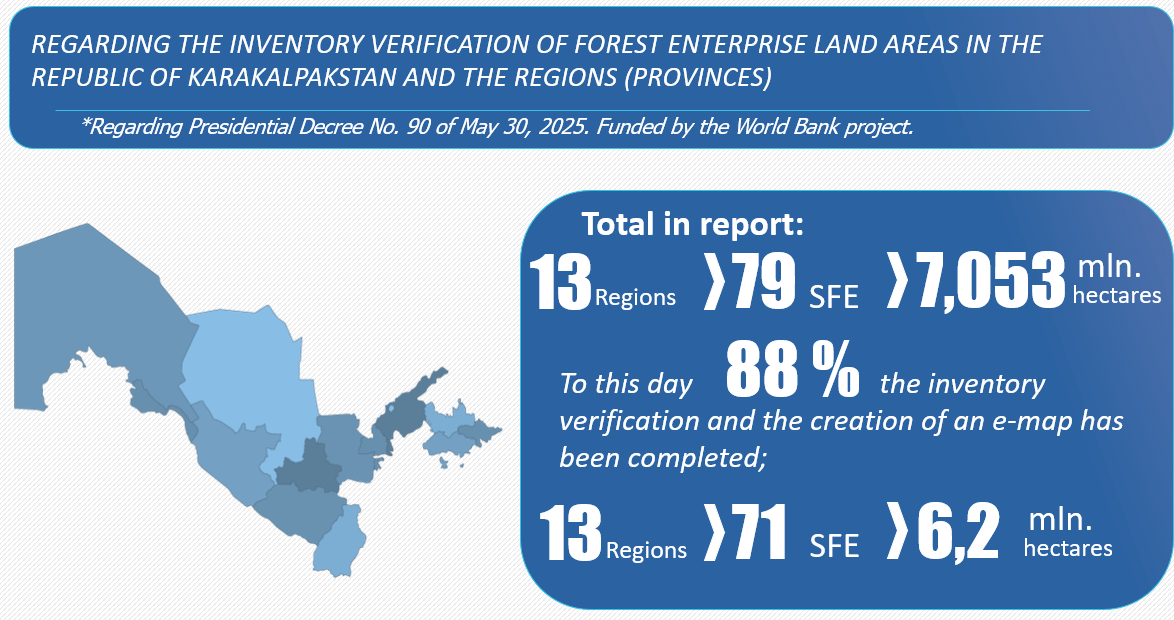
According to the presentation delivered by the Cadastre Agency – Republican Aerogeodetic Center during the technical meeting held on 2 March 2026, the total State Forest Fund (SFF) area of Uzbekistan is estimated at approximately 7.053 million hectares.
As part of the ongoing forest land verification and cadastral mapping activities, inventory validation and electronic mapping have been completed for approximately 6.2 million hectares of land under 71 State Forestry Enterprises (SFEs), representing about 88 percent of the total State Forest Fund area.
It should be noted that the State Forest Fund does not consist solely of natural forests in the classical sense. Rather, it represents a complex landscape system that includes multiple land-use categories managed under the forestry administration framework. Within this system, the forest fund encompasses a broad range of land types, including:
- natural forest ecosystems
- plantation forests
- poplar plantations
- protective forest belts (shelterbelts)
- shrublands and semi-natural vegetation areas
- young afforestation and reforestation sites
- pasture and grazing lands
- agricultural and agroforestry areas
According to the verified inventory data, approximately 4.44 million hectares of the State Forest Fund are classified as forest ecosystems, while the remaining areas consist of various land-use categories that contribute to the broader landscape management, ecological stabilization, and protective functions of the forestry sector.
The completion of the inventory verification and electronic mapping process represents a significant step toward improving the accuracy of forest resource information, strengthening cadastral registration of forest lands, and providing a reliable spatial data foundation for forest governance and planning. These datasets also play an important role in supporting restoration planning and species-site matching for afforestation and landscape rehabilitation activities, including the development and operation of forestry nurseries under the RESILAND CA+ project.
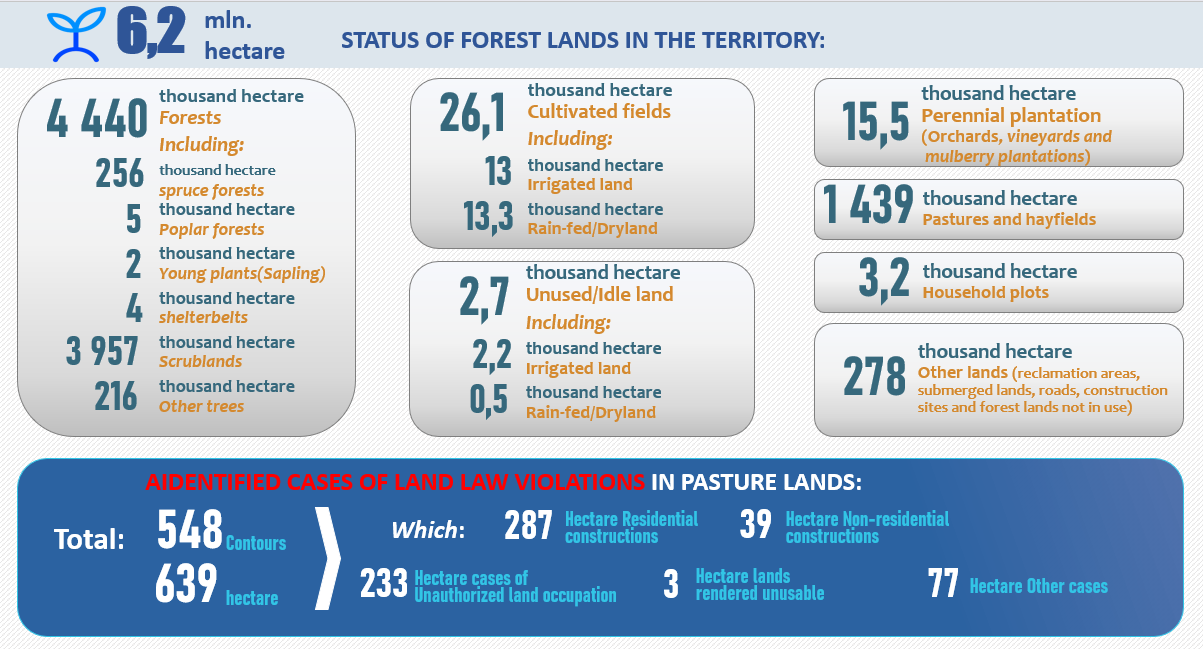

The structure of forest ecosystems within the State Forest Fund shows that the majority of the forest area consists of scrubland vegetation (approximately 89%), primarily desert and semi-desert shrub formations dominated by species such as Haloxylon and Tamarix. Mountain spruce forests (Picea spp.) account for about 5.8% of the forest area, while other tree formations and plantations represent smaller shares of the total forest cover.
| Forest Type (English) | O‘zbekcha nomi | Scientific Name (Latin) | Area (thousand ha) | Share (%) |
|---|---|---|---|---|
| Spruce forests | Spruce o‘rmonlari | Picea spp. | 256 | 5.77 % |
| Poplar forests | Terak o‘rmonlari | Populus spp. | 5 | 0.11 % |
| Young plants (saplings) | Yosh ko‘chatlar | various species | 2 | 0.05 % |
| Shelterbelts | Himoya o‘rmon polosalari | mixed species (Populus, Ulmus, Elaeagnus) | 4 | 0.09 % |
| Scrublands | Butazorlar / butali o‘simliklar | mainly Haloxylon spp., Tamarix spp. | 3,957 | 89.12 % |
| Other trees | Boshqa daraxt turlari | various species | 216 | 4.86 % |
| TOTAL | Jami | — | 4,440 | 100 % |
2.2.Strategic Implications for the RESILAND CA+ Nursery System
The verified land structure presented during the recent technical briefings provides an important overview of the current distribution of forest-related lands in Uzbekistan following the cadastral verification and electronic mapping process.
According to the available data, approximately 6.2 million hectares of land managed under 71 State Forestry Enterprises (SFEs) have been verified and digitally mapped, representing roughly 88 percent of the reported State Forest Fund area. Within this verified territory, approximately 4.44 million hectares are classified as forest ecosystems, while the remaining areas consist of other land-use categories including pastures, cultivated fields, perennial plantations, household plots, idle land, and other non-forest land uses. These figures clearly demonstrate the multifunctional character of land managed under the forestry administration framework.
An important feature of forest land classification in Uzbekistan is that the category “forest” does not refer exclusively to dense, closed-canopy natural forest stands in the conventional sense. Instead, forest ecosystems include a wide range of formations such as spruce forests, poplar plantations, young plantations, shelterbelts, scrublands, and other tree formations, with scrublands constituting by far the largest share of the total forest ecosystem area.
This structure reflects the ecological reality of Uzbekistan, where forests and tree-based landscapes primarily perform protective, stabilizing, hydrological, and restoration functions, rather than predominantly serving as timber production systems. In practice, the forest sector is closely associated with desert and semi-desert stabilization, riparian corridor restoration, mountain watershed protection, erosion control, and shelterbelt systems in agricultural areas.
The forest landscapes of Uzbekistan are also ecologically diverse. In desert and semi-desert plains, saxaul shrub woodlands and associated dryland vegetation dominate large parts of the landscape, with Haloxylon spp. and Tamarix spp. representing key species for land stabilization and reclamation.
In river valleys, tugai forests form highly valuable riparian ecosystems under specific ecological conditions characterized by shallow groundwater, periodic flooding, hot dry summers, and low humidity. Primary tugai forest-forming species include native poplars (Populus diversifolia, Populus pruinosa), Russian olive (Elaeagnus angustifolia), willow (Salix songarica), and tamarix, together with a wider assemblage of roughly 40 typical tugai-associated plant species.
These mosaic riparian ecosystems also support important wildlife, including reptiles, birds, mammals, rodents, and ungulates such as the Bukhara deer.
However, tugai forests are now highly fragmented and severely threatened. The largest remaining dispersed tugai areas are found in Karakalpakstan, where approximately 30,000 hectares remain, representing a small fraction of their former extent but still a nationally and regionally significant biodiversity resource.
At the same time, the broader land-use structure of the country shows that Uzbekistan is fundamentally a tree-scarce but highly managed agricultural and pastoral landscape. Around 10 percent of the national territory is intensively cultivated, mainly in river valleys and oases sustained by extensive irrigation systems, and roughly 82 percent of arable land is irrigated. Some foothill areas receiving more than 350 mm of annual rainfall support non-irrigated agriculture and agroforestry.
Livestock production accounts for about 40 percent of gross agricultural output, while agriculture as a whole consumes around 90 percent of national water use. These systems face major structural challenges including high water consumption, inefficiency of irrigation systems, declining soil fertility, and widespread salinization.
This context is highly relevant for nursery planning, because it means that the greatest future demand for seedlings may emerge not only from forest lands, but also from agricultural landscapes, riparian systems, degraded drylands, pasture restoration areas, and urban green infrastructure.
The same verified land structure supports this conclusion. Within the verified area under forestry administration, approximately 26.1 thousand hectares are classified as cultivated land, 15.5 thousand hectares as perennial plantations (including orchards, vineyards, and mulberry plantations), and about 1.439 million hectares as pastures and hayfields. Additional areas include idle land, household plots, reclamation areas, infrastructure corridors, roads, and unused forest lands. This confirms that forestry management in Uzbekistan operates within a multi-functional landscape system, not within a narrowly defined forest-only domain. Forestry and agriculture are therefore not separate systems; they are spatially and functionally interlinked.
2.2.1.Implications for the RESILAND CA+ Nursery System
These land-use realities have direct implications for the design and strategic orientation of the nursery system under RESILAND CA+. Nurseries in Uzbekistan should not be understood merely as production facilities for conventional reforestation stock. Rather, they should be conceived as multi-purpose biological infrastructure serving restoration, agriculture, climate adaptation, rural development, and green economic transformation. This is fully consistent with the project’s development objective to increase the area under sustainable landscape management in selected locations of Uzbekistan, while also supporting wider regional restoration cooperation.
Under this broader perspective, the future nursery system should support a wide portfolio of planting and restoration uses, including:
- afforestation and reforestation in ecologically suitable areas;
- restoration of degraded lands within the State Forest Fund;
- enrichment planting in scrublands and semi-natural woody ecosystems;
- establishment of protective forest belts and windbreaks in irrigated agricultural landscapes;
- agroforestry systems integrating productive tree species with farming;
- canal-side, riverbank, roadside, and watershed stabilization planting;
- restoration of degraded pastures and support to grass and forage productivity;
- urban and peri-urban landscaping, including the production of large-sized ornamental trees for parks, streets, schools, hospitals, and public spaces;
- greening of cemeteries, sacred sites, and socially significant public landscapes;
- production of medicinal and aromatic plants such as lavender and rosemary;
- production of fruit and multipurpose trees such as wild apple, poplar, and other locally adapted income-generating species;
- planting systems supporting beekeeping and pollinator habitats;
- biodiversity-supporting and wildlife-oriented planting material;
- certified seedling production for export markets and regional demand;
- eventual leasing or concession-based operation of selected nursery units under public-private partnership models.
This expanded role is important because Uzbekistan’s ecological conditions do not generally justify a narrow policy focus on creating dense, closed, highly productive forests everywhere. In many parts of the country, that would be ecologically unrealistic and, in some locations, undesirable. Instead, the country offers significant potential for a broader tree-based landscape economy, in which vegetation is used to deliver ecological services, support agricultural productivity, create climate benefits, and generate income.
2.2.2. Carbon, Climate, and Investment Dimensions
A particularly important opportunity lies in linking nursery production with carbon-oriented restoration pathways. Uzbekistan’s land structure suggests considerable potential for carbon afforestation, protective planting, ecological corridor development, and restoration projects compatible with voluntary carbon mechanisms and future compliance-oriented systems. Planting systems aligned with Voluntary Carbon Markets (VCM), Gold Standard-type methodologies, and future national or regional emissions trading arrangements (ETS) may provide an additional rationale for scaling up nursery production, provided that site selection, baseline assessment, monitoring, and permanence considerations are handled properly.
This is especially relevant for the Aral Sea Basin and the Dried Seabed of the Aral Sea (DSAS), where large-scale restoration has already been undertaken under extremely harsh ecological conditions. Field observations and expert reviews suggest that although survival rates under these conditions may appear low in conventional forestry terms, they may still represent satisfactory and even successful outcomes given the salinity, temperature extremes, hydrological instability, and soil toxicity of the area. Experience from the region also indicates that restoration should not rely on monocultures alone. Species such as saxaul (Haloxylon ammodendron), Karelinia caspia, Tamarix hispida, Halostachys belangeriana, Aeluropus littoralis, and Calligonum spp. are especially valuable in highly saline and dry conditions, and mixed-species approaches may significantly improve ecological resilience and stabilization outcomes.
The broader policy implication is that nursery systems should be designed not only to meet planting targets, but also to support investment-ready restoration models. This includes production systems linked with:
- carbon sequestration projects;
- ecological infrastructure for dust and sand transport mitigation;
- green belts for flood and erosion reduction;
- riparian and canal-based ecological corridor development;
- restoration-compatible agri-business models;
- public-private partnerships in composting, substrate production, and nursery operations;
- certified production systems for regional and international seedling markets.
2.2.3. Land Availability for the National Seedling Target
A key strategic question is whether sufficient land exists in Uzbekistan to absorb the national target of 200 million seedlings per year. The answer is potentially yes, but only if the target is understood within a multi-landscape restoration framework rather than as a target for conventional dense forest plantation alone.
Seedlings can be absorbed through several distinct pathways:
- Degraded lands within the State Forest Fund
Not all land managed under forestry administration is currently classified as forest ecosystem. This creates room for rehabilitation, enrichment planting, assisted natural regeneration, and ecological recovery. - Scrublands and semi-forest landscapes
Since scrublands form a large share of current forest ecosystems, they offer scope for diversification, enrichment, and stabilization interventions rather than conventional plantation forestry alone. - Agricultural landscapes
Uzbekistan’s extensive irrigated and semi-irrigated farming systems can absorb large numbers of seedlings through shelterbelts, windbreaks, agroforestry, farm boundary planting, canal protection systems, and roadside corridors. - Aral Sea region and desert reclamation
The DSAS and surrounding drylands remain a major restoration frontier capable of absorbing substantial numbers of drought-adapted shrubs and woody plants. - Urban and peri-urban greening
Densely populated regions generate continuing demand for street trees, landscape species, public space planting, and civic greenery. - Replacement and phased planting
Annual production is not equal to net annual forest expansion. A significant share of seedlings is required for gap filling, replacement planting, mortality compensation, trial planting, and phased restoration programs.
From a practical perspective, if planting density is assumed at 2,500 seedlings per hectare, 200 million seedlings would correspond to about 80,000 hectares. At 1,100 seedlings per hectare, the same amount would correspond to around 181,800 hectares.
At lower densities, such as those typical of dryland shrub planting, agroforestry, or linear shelterbelt systems, the same number of seedlings could be distributed across much larger areas. Therefore, the target is not spatially unrealistic. The critical issue is not whether land exists, but whether the country can identify well-prepared, ecologically matched, and properly prioritized planting sites every year.
2.2.4. Technical and Ecological Considerations for Nursery Production
The ecological fragility of many Uzbek landscapes requires caution. Artificial interventions should not be carried out indiscriminately in poorly planned or ecologically unsuitable locations. Restoration should be based on careful assessment of site conditions, ecosystem sensitivity, hydrology, salinity, species suitability, and long-term maintenance feasibility. In highly fragile ecosystems, allowing natural regeneration or reducing pressure may be more appropriate than direct planting.
Where active planting is justified, nursery production must be adapted to the realities of seedling survival. In arid and restoration-sensitive conditions, bare-root production should generally be minimized unless clearly justified, because planting success depends heavily on root protection and post-planting stress resistance. Containerized seedlings are likely to be more suitable in many target landscapes. In addition, advanced propagation systems such as in vitro tissue culture may be considered for the multiplication of selected genotypes and difficult-to-propagate priority species.
There is also scope to link nursery operations with waste collection, composting, and substrate production systems through publicly supported pilot PPP arrangements. Such systems could support both nursery quality and local green employment. As part of pilot implementation, nursery development, composting, planting, and maintenance operations could generate 100–200 jobs per pilot unit, with priority given to youth, women, and communities in drought-affected or economically vulnerable areas.
2.2.5. Strategic Role of the Nine Nurseries
Within this overall framework, the nine RESILAND CA nurseries should be understood as a nationally distributed strategic production system, not simply as isolated seedling sites. Their role is to produce the right planting material for the right landscapes, including:
- drought-resistant species for desert and dryland restoration;
- mountain and foothill species for watershed protection and slope stabilization;
- shelterbelt and agroforestry species for agricultural landscapes;
- medicinal, aromatic, fruit, and multipurpose species for rural income generation;
- ornamental and large-sized planting material for urban landscaping;
- ecologically valuable native species supporting biodiversity and habitat restoration;
- potentially certified nursery stock for export and regional cooperation.
In this sense, the nursery system becomes the practical mechanism that connects:
forest and land data → ecological planning → restoration priorities → nursery production → field implementation
Without a geographically distributed, technically differentiated, and ecologically informed nursery network, large national seedling targets risk remaining largely numerical. With such a system, however, they can be translated into a coherent program of landscape restoration, climate adaptation, rural development, and green economic opportunity.
3. Individual Nursery Assessments and Technical Feasibility Analysis
Table: Forestry Nurseries Assessed under the RESILAND CA+ Project (Alphabetical Order by Region)
| No. | Region | Nursery Name (English) | Fidanlık nomi (O‘zbekcha) |
|---|---|---|---|
| 1 | Jizzakh Region | G’allaorol State Forestry Enterprises – Qoravultepa Forest Section Nursery | G‘allaorol davlat o‘rmon xo‘jaligi Qoravultepa o‘rmon bo‘limi fidanligi |
| 2 | Kashkadarya Region | Kitob State Forestry Enterprises Nursery | Kitob davlat o‘rmon xo‘jaligi fidanligi |
| 3 | Kashkadarya Region | Sho‘rtan State Forestry Enterprises Nursery | Sho‘rtan davlat o‘rmon xo‘jaligi fidanligi |
| 4 | Namangan Region | Namangan Central State Forestry Enterprises Nursery | Namangan markaziy davlat o‘rmon xo‘jaligi fidanligi |
| 5 | Namangan Region | O‘rta Orol State Forestry Enterprises Nursery | O‘rta Orol davlat o‘rmon xo‘jaligi fidanligi |
| 6 | Samarkand Region | Dargom Specialized State Forest Seedling Production Enterprise Nursery | Darg‘om ixtisoslashtirilgan davlat o‘rmon ko‘chat yetishtirish korxonasi fidanligi |
| 7 | Samarkand Region | Samarkand Central State Forestry – Pastdargʻom Forest Section Nursery | Samarqand markaziy davlat o‘rmon xo‘jaligi Pastdargʻom o‘rmon bo‘limi fidanligi |
| 8 | Surkhandarya Region | Surkhandarya State Forestry Enterprises Nursery | Surxondaryo davlat o‘rmon xo‘jaligi fidanligi |
| 9 | Surkhandarya Region | Uzun State Forestry Enterprises Nursery | Uzun davlat o‘rmon xo‘jaligi fidanligi |
3.1 G’allaorol State Forestry Enterprises – Qoravultepa Forest Section Nursery (Jizzakh Region)
Basic Information and Preliminary Assessment of Qoravultepa Forest Section Nursery
(G‘allaorol State Forestry Enterprise, Jizzakh Region)
| Category | Parameter | Value | Notes |
|---|---|---|---|
| Basic Identification | Nursery Name | G’allaorol State Forestry Enterprises – Qoravultepa Forest Section Nursery | |
| Forest Enterprise | G‘allaorol Specialized State Forestry Enterprise | ||
| Region (Viloyat) | Jizzakh Region | ||
| District (Tumani) | G’allaorol District | ||
| Forest Enterprise Structure | Forest Area (ha) | To be verified | |
| Non-Forest Area (ha) | To be verified | ||
| Total Enterprise Area (ha) | To be verified | ||
| Neighboring Forest Enterprises | To be verified | ||
| Nursery Site Characteristics | Nursery Area (ha) | 11 ha | nursery establishment site |
| Geographic Coordinates | 39°51’03.8″N 67°32’27.5″E
RGMF+Q8, Karaultepa, Jizzakh Region, Uzbekistan |
cadastral map | |
| Elevation (m) | approx. 400–800 m | foothill zone | |
| Administrative Context | District Population | approx. 170,000 | |
| Vilayet Population | approx. 1.4 million | ||
| Environmental Conditions | Climate Zone | Semi-arid continental | |
| Soil Type | Steppe / alluvial soils | to be verified | |
| Water Source | irrigation canal / groundwater | to be verified | |
| Irrigation System | surface irrigation (expected) | ||
| Infrastructure | Electricity Access | To be verified | |
| Water Supply Infrastructure | Close to Qaraultepa suvombori (dam) | To be verified | |
| Internal Roads | basic access roads | ||
| Existing Buildings | No | To be verified | |
| Transport Accessibility | Nearest Highway / Main Road | regional road network | distance to be verified |
| Nearest Railway | Jizzakh Railway Station | distance to be verified | |
| Nearest Airport | Samarkand International Airport | approx. 120–140 km | |
| Operational Context | Agricultural Shelterbelt Demand | High | |
| Landscape Restoration Demand | Medium–High | ||
| Urban Greening Demand | Medium | ||
| Estimated Planting Demand in Service Area (ha/year) | To be estimated | ||
| Production Planning | Current Annual Seedling Production Capacity | To be assessed | |
| Proposed Annual Seedling Production Capacity | up to 1 million seedlings/year | small nursery | |
| Main Production System | bare-root + container | recommended | |
| Strategic Functions (Potential) | Training Center | ☐No | |
| Seed Stands | ☐No | ||
| Seed Orchard | ☐No | ||
| Seed Processing Unit | ☐Yes | ||
| Seed & Seedling Sales Center | No | local distribution | |
| Container Nursery | ☑ | ||
| Tissue Culture / In Vitro Lab | ☐ | ||
| Demonstration / Pilot Restoration Site | ☑ | ||
| Compost / Substrate Production | ☑ | ||
| Decision Framework | Small Nursery (≤1 million seedlings/year) | ☑ | Forest section level |
| Medium Nursery (1–5 million seedlings/year) | ☐ | ||
| Regional Nursery (>5 million seedlings/year) | ☐ | ||
| Regional Nursery + Training Center | ☐ | ||
| Advanced Nursery + Tissue Culture Facility | ☐ |
3.2 Kitob State Forestry Enterprises Nursery (Kashkadarya Region)
Basic Information and Preliminary Assessment of Kitob State Forestry Enterprises Nursery
(Kitob State Forestry Enterprise, Kashkadarya Region)
| Category | Parameter | Value | Notes |
|---|---|---|---|
| Basic Identification | Nursery Name | Kitob State Forestry Enterprises Nursery | |
| Forest Enterprise | Kitob State Forestry Enterprise | ||
| Region (Viloyat) | Kashkadarya Region | ||
| District (Tumani) | Kitob District | ||
| Forest Enterprise Structure | Forest Area (ha) | 39,541.8 ha | Cadastre inventory |
| Non-Forest Area (ha) | 23,986.1 ha | Calculated | |
| Total Enterprise Area (ha) | 63,527.9 ha | Cadastre dataset | |
| Neighboring Forest Enterprises | Yakkabog, Shahrisabz, Qamashi | Regional forestry network | |
| Nursery Site Characteristics | Nursery Area (ha) | 30 ha | Detailed design phase |
| Geographic Coordinates | 39°8’33″N, 66°48’17″E | GIS verification required | |
| Elevation (m) | approx. 600–650 m a.s.l. | Foothill belt | |
| Administrative Context | District Population | approx. 280,000–300,000 | Regional statistics |
| Province Population | approx. 3.4 million | Kashkadarya Region | |
| Environmental Conditions | Climate Zone | Semi-arid continental foothill climate | |
| Mean Annual Temperature | 13–15 °C | ||
| Summer Maximum Temperature | up to 38–40 °C | ||
| Annual Precipitation | approx. 350–450 mm | ||
| Soil Type | Sierozem and alluvial soils | ||
| Water Source | Mountain runoff, irrigation canals and groundwater | ||
| Irrigation System | Surface irrigation | modernization recommended | |
| Infrastructure | Electricity Access | Available | forestry facilities |
| Water Supply Infrastructure | Groundwater and irrigation canals | ||
| Internal Roads | Forestry service roads | ||
| Existing Buildings | Existing nursery infrastructure | modernization needed | |
| Transport Accessibility | Nearest Highway / Main Road | Shahrisabz–Kitob regional highway | |
| Nearest Railway | Shahrisabz railway station | distance to be verified | |
| Nearest Airport | Samarkand International Airport | approx. 90–110 km | |
| Operational Context | Agricultural Shelterbelt Demand | Medium | |
| Landscape Restoration Demand | High | mountain watershed restoration | |
| Urban Greening Demand | Medium | ||
| Estimated Planting Demand in Service Area (ha/year) | approx. 200–300 ha/year | restoration + agroforestry | |
| Production Planning | Current Annual Seedling Production Capacity | To be assessed | seedlings/year |
| Proposed Annual Seedling Production Capacity | 5–8 million seedlings/year (preliminary) | regional nursery potential | |
| Main Production System | Container + open-field system | recommended | |
| Strategic Functions (Potential) | Training Center | ☑ Kitob Forestry Bureau (Kitab FO) | mountain forestry training hub |
| Seed Stands | No | ||
| Seed Orchard | ☑ | pistachio, walnut | |
| Seed Processing Unit | ☑ | ||
| Seed & Seedling Sales Center | ☑ Kitob Forestry Bureau (Kitab FO) | ||
| Container Nursery | ☑ | priority | |
| Tissue Culture / In Vitro Lab | ☐ | optional | |
| Demonstration / Pilot Restoration Site | ☑ | watershed restoration | |
| Compost / Substrate Production | ☑ | ||
| Decision Framework | Small Nursery (≤1 million seedlings/year) | ☐ | |
| Medium Nursery (1–5 million seedlings/year) | ☐ | ||
| Regional Nursery (>5 million seedlings/year) | ☑ | ||
| Regional Nursery + Training Center | ☑ | recommended | |
| Advanced Nursery + Tissue Culture Facility | ☐ | optional |
3.3 Sho‘rtan State Forestry Enterprises Nursery (Kashkadarya Region)
Basic Information and Preliminary Assessment – Sho‘rtan State Forestry Enterprises Nursery (Kashkadarya Region)
| Category | Parameter | Value | Notes |
|---|---|---|---|
| Basic Identification | Nursery Name | Sho‘rtan State Forestry Enterprises Nursery | |
| Forest Enterprise | Sho‘rtan State Forestry Enterprise | ||
| Vilayet | Kashkadarya Vilayet | ||
| District (Tumani) | Qarshi District | ||
| Forest Enterprise Structure | Forest Area (ha) | 7,003.9 ha | Cadastre inventory |
| Non-Forest Area (ha) | 4,407.3 ha | Calculated | |
| Total Enterprise Area (ha) | 11,411.2 ha | Cadastre dataset | |
| Neighboring Forest Enterprises | Kitob, Shahrisabz, Muborak | ||
| Nursery Site Characteristics | Nursery Area (ha) | 9,6 ha | Existing nursery area |
| Geographic Coordinates | 38.935246° N, 65.640578° E | GIS verification required | |
| Elevation (m) | approx. 350–400 m | Lowland steppe zone | |
| Administrative Context | District Population | approx. 260,000–300,000 | Qarshi urban area |
| Vilayet Population | approx. 3.4 million | Kashkadarya Vilayet | |
| Environmental Conditions | Climate Zone | Semi-arid continental lowland climate | |
| Mean Annual Temperature | 14–16 °C | ||
| Summer Maximum Temperature | often above 40 °C | ||
| Annual Precipitation | approx. 250–320 mm | ||
| Soil Type | Sierozem and irrigated alluvial soils | ||
| Water Source | Irrigation canals and groundwater | ||
| Irrigation System | Irrigation-dependent production | ||
| Infrastructure | Electricity Access | Available | |
| Water Supply Infrastructure | Canal irrigation system | ||
| Internal Roads | Forestry access roads | ||
| Existing Buildings | Basic nursery infrastructure | modernization recommended | |
| Transport Accessibility | Nearest Highway / Main Road | Qarshi regional highway network | |
| Nearest Railway | Qarshi railway station | ||
| Nearest Airport | Qarshi International Airport | ||
| Operational Context | Agricultural Shelterbelt Demand | High | wind protection for agricultural fields |
| Landscape Restoration Demand | High | desertification control | |
| Urban Greening Demand | Medium | ||
| Estimated Planting Demand in Service Area (ha/year) | approx. 300–400 ha/year | ||
| Production Planning | Current Annual Seedling Production Capacity | To be assessed | seedlings/year |
| Proposed Annual Seedling Production Capacity | 3–5 million seedlings/year | medium nursery | |
| Main Production System | Container seedling production | recommended | |
| Strategic Functions (Potential) | Training Center | ☐ | |
| Seed Orchard | ☑ | drought-resistant species | |
| Seed Processing Unit | ☑ | ||
| Seed & Seedling Sales Center | ☑ | ||
| Container Nursery | ☑ | priority | |
| Tissue Culture / In Vitro Lab | ☐ | optional | |
| Demonstration / Pilot Restoration Site | ☑ | ||
| Compost / Substrate Production | ☑ | ||
| Decision Framework | Small Nursery (≤1 million seedlings/year) | ☐ | |
| Medium Nursery (1–5 million seedlings/year) | ☑ | recommended | |
| Regional Nursery (>5 million seedlings/year) | ☐ | ||
| Regional Nursery + Training Center | ☐ | ||
| Advanced Nursery + Tissue Culture Facility | ☐ |
3.4 Namangan Central State Forestry Enterprises Nursery (Namangan Region)
Table 3.4 Basic Information and Preliminary Assessment of Namangan Central State Forestry Enterprises Nursery
| Category | Parameter | Value | Notes |
|---|---|---|---|
| Basic Identification | Nursery Name | Namangan Central State Forestry Enterprises Nursery (Terakzor Division) | |
| Forest Enterprise | Namangan Specialized State Forestry Enterprise | ||
| Vilayet | Namangan Vilayet | ||
| District (Tumani) | Uchqo‘rg‘on District | ||
| Forest Enterprise Structure | Forest Area (ha) | 661 ha | Cadastre inventory |
| Non-Forest Area (ha) | 2,108 ha | agricultural lands and settlements | |
| Total Enterprise Area (ha) | 2,769 ha | Cadastre dataset | |
| Neighboring Forest Enterprises | O‘rta Orol SFE and other valley forestry units | ||
| Nursery Site Characteristics | Nursery Area (ha) | 10 ha (expanding capacity) | allocated nursery parcel |
| Geographic Coordinates | 41.095397, 72.053397 | ||
| Elevation (m) | approx. 480 m | Fergana Valley floodplain | |
| Administrative Context | District Population | approx. 180,000 | Uchqo‘rg‘on District |
| Vilayet Population | >2.9 million | Namangan Vilayet | |
| Environmental Conditions | Climate Zone | Continental irrigated valley climate | |
| Mean Annual Temperature | 13–15 °C | ||
| Summer Maximum Temperature | 34–38 °C | ||
| Annual Precipitation | 220–300 mm | ||
| Soil Type | Alluvial floodplain soils | gravelly texture | |
| Water Source | Irrigation canals (Syr Darya basin) | ||
| Irrigation System | Canal irrigation | modernization recommended | |
| Infrastructure | Electricity Access | Available | |
| Water Supply Infrastructure | Irrigation canal network | ||
| Internal Roads | Agricultural access roads | improvement recommended | |
| Existing Buildings | Small service structures | ||
| Transport Accessibility | Nearest Highway | Uchqo‘rg‘on–Namangan regional road | |
| Nearest Railway | Namangan railway station | ||
| Nearest Airport | Namangan International Airport | ||
| Operational Context | Agricultural Shelterbelt Demand | Very High | irrigated agriculture |
| Landscape Restoration Demand | Medium | valley ecosystems | |
| Urban Greening Demand | High | Namangan city | |
| Estimated Planting Demand in Service Area (ha/year) | approx. 600–900 ha/year | Fergana Valley | |
| Production Planning | Current Annual Seedling Production Capacity | Traditional open-field nursery | to be verified |
| Proposed Annual Seedling Production Capacity | 5–8 million seedlings/year | regional nursery | |
| Main Production System | Open field + container production | recommended | |
| Strategic Functions (Potential) | Training Center | Yes | |
| Seed Orchard | Yes | shelterbelt species | |
| Seed Stand | Yes | ||
| Seed Processing Unit | Yes | ||
| Seed & Seedling Sales Center | Yes | ||
| Container Nursery | Yes | priority | |
| Tissue Culture / In Vitro Lab | Yes | optional | |
| Demonstration / Pilot Restoration Site | Yes | ||
| Compost / Substrate Production | Yes | ||
| Decision Framework | Small Nursery (≤1 million seedlings/year) | No | |
| Medium Nursery (1–5 million seedlings/year) | No | ||
| Regional Nursery (>5 million seedlings/year) | Yes | recommended | |
| Regional Nursery + Training Center | Yes | ||
| Advanced Nursery + Tissue Culture Facility | No |
3.5 O‘rta Orol State Forestry Enterprises Nursery (Namangan Region)
Table 3.5 Basic Information and Preliminary Assessment of O‘rta Orol State Forestry Enterprises Nursery
| Category | Parameter | Value | Notes |
|---|---|---|---|
| Basic Identification | Nursery Name | O‘rta Orol State Forestry Enterprises Nursery | |
| Forest Enterprise | O‘rta Orol State Forestry Enterprise | ||
| Vilayet | Namangan Vilayet | ||
| District (Tumani) | Uchqo‘rg‘on District | ||
| Forest Enterprise Structure | Forest Area (ha) | 337 ha | Cadastre inventory |
| Non-Forest Area (ha) | approx. 329 ha | agricultural lands and infrastructure | |
| Total Enterprise Area (ha) | approx. 666 ha | national forest land inventory | |
| Neighboring Forest Enterprises | Namangan Central SFE and other valley forestry units | ||
| Nursery Site Characteristics | Nursery Area (ha) | 5 ha (expanding capacity to 20 ha) | detailed design phase |
| Geographic Coordinates | 40.930639, 71.817056 | ||
| Elevation (m) | approx. 470–480 m | Fergana Valley floodplain | |
| Administrative Context | District Population | approx. 180,000 | Uchqo‘rg‘on District |
| Vilayet Population | approx. 2.9 million | Namangan Vilayet | |
| Environmental Conditions | Climate Zone | Continental irrigated valley climate | |
| Mean Annual Temperature | 13–15 °C | ||
| Summer Maximum Temperature | 34–38 °C | ||
| Annual Precipitation | approx. 220–300 mm | ||
| Soil Type | Alluvial sandy-loam soils with gravel | floodplain sediments | |
| Water Source | Irrigation canals connected to Kara Darya / Syr Darya basin | ||
| Irrigation System | Canal-based irrigation | modernization recommended | |
| Infrastructure | Electricity Access | Available in surrounding settlements | |
| Water Supply Infrastructure | Irrigation canal network | ||
| Internal Roads | Agricultural and forestry access roads | ||
| Existing Buildings | Basic forestry service structures | ||
| Transport Accessibility | Nearest Highway | Regional agricultural road network (R-122 corridor) | |
| Nearest Railway | Namangan railway station | ||
| Nearest Airport | Namangan International Airport | ||
| Operational Context | Agricultural Shelterbelt Demand | High | Fergana Valley agriculture |
| Landscape Restoration Demand | Medium | valley ecosystems | |
| Urban Greening Demand | Medium | ||
| Estimated Planting Demand in Service Area (ha/year) | approx. 200–300 ha/year | local service area | |
| Production Planning | Current Annual Seedling Production Capacity | Traditional open-field planting system | to be verified |
| Proposed Annual Seedling Production Capacity | 0.5–1 million seedlings/year | small nursery | |
| Main Production System | Open field + limited container production | ||
| Seed Resources and Genetic Infrastructure | Seed Stand (Seed Production Stand) | No | insufficient forest area |
| Seed Orchard | Possible | small demonstration block | |
| Seed Collection Area Available | Limited | small enterprise area | |
| Certified Seed Production Potential | Limited | ||
| Strategic Functions (Potential) | Training Center | No | |
| Seed Processing Unit | No | centralized at Namangan | |
| Seed & Seedling Sales Center | Possible | local distribution | |
| Container Nursery | Yes | small-scale | |
| Tissue Culture / In Vitro Lab | No | ||
| Demonstration / Pilot Restoration Site | Yes | ||
| Compost / Substrate Production | Possible | ||
| Decision Framework | Small Nursery (≤1 million seedlings/year) | Yes | recommended |
| Medium Nursery (1–5 million seedlings/year) | No | ||
| Regional Nursery (>5 million seedlings/year) | No | ||
| Regional Nursery + Training Center | No | ||
| Advanced Nursery + Tissue Culture Facility | No |
3.6 Dargom Specialized State Forest Seedling Production Enterprise Nursery (Samarkand Region)
Table 3.6 Basic Information and Preliminary Assessment of Dargom Specialized State Forest Seedling Production Enterprise Nursery
| Category | Parameter | Value | Notes |
|---|---|---|---|
| Basic Identification | Nursery Name | Dargom Specialized State Forest Seedling Production Enterprise Nursery | |
| Forest Enterprise | Dargom Specialized State Forest Seedling Production Enterprise | ||
| Vilayet | Samarkand Vilayet | ||
| District (Tumani) | Tayloq District | ||
| Forest Enterprise Structure | Forest Area (ha) | approx. 140 ha | Cadastre inventory |
| Non-Forest Area (ha) | approx. 182 ha | agricultural and operational lands | |
| Total Enterprise Area (ha) | approx. 322 ha | national forest land inventory | |
| Neighboring Forest Enterprises | Samarkand Central SFE and other regional forestry units | ||
| Nursery Site Characteristics | Nursery Area (ha) | approx.50 ha (expanding capacity to 294 ha) | total operational area of the enterprise |
| Geographic Coordinates | 39.543806, 67.046889 | ||
| Elevation (m) | approx. 700–750 m | Zarafshan basin plain | |
| Administrative Context | District Population | approx. 200,000 | Tayloq District |
| Vilayet Population | approx. 4 million | Samarkand Vilayet | |
| Environmental Conditions | Climate Zone | Semi-arid continental climate | |
| Mean Annual Temperature | approx. 14–15 °C | ||
| Summer Maximum Temperature | 36–40 °C | ||
| Annual Precipitation | approx. 300 mm | ||
| Soil Type | Alluvial irrigated soils | Zarafshan basin | |
| Water Source | Irrigation canals connected to Zarafshan River basin | ||
| Irrigation System | Canal irrigation and groundwater | modernization recommended | |
| Infrastructure | Electricity Access | Available | |
| Water Supply Infrastructure | Irrigation canal network | ||
| Internal Roads | Functional internal access roads | ||
| Existing Buildings | Administrative and operational structures | ||
| Transport Accessibility | Nearest Highway | M39 international corridor | |
| Distance to Samarkand City | approx. 20–25 km | ||
| Nearest Railway | Samarkand railway station | ||
| Nearest Airport | Samarkand International Airport | ||
| Operational Context | Agricultural Shelterbelt Demand | High | irrigated agriculture |
| Landscape Restoration Demand | High | Zarafshan basin | |
| Urban Greening Demand | High | Samarkand metropolitan area | |
| Estimated Planting Demand in Service Area (ha/year) | approx. 1,000–1,500 ha/year | Samarkand region | |
| Production Planning | Current Annual Seedling Production Capacity | Existing nursery production | to be verified |
| Proposed Annual Seedling Production Capacity | >10 million seedlings/year | regional nursery hub | |
| Main Production System | Open field + container nursery | ||
| Seed Resources and Genetic Infrastructure | Seed Stand (Seed Production Stand) | Yes | existing pine plantations |
| Seed Orchard | Yes | potential for improved seed production | |
| Seed Collection Area Available | Yes | large enterprise area | |
| Certified Seed Production Potential | High | suitable for regional supply | |
| Strategic Functions (Potential) | Forestry Training Center | Yes | |
| Medicinal and Aromatic Plants Production Area | Yes | lavender, jujube | |
| Seed Processing Unit | Yes | ||
| Seed & Seedling Sales Center | Yes | ||
| Container Nursery | Yes | large-scale production | |
| Tissue Culture / In Vitro Lab | Possible | medium–long term | |
| Demonstration / Pilot Restoration Site | Yes | ||
| Beekeeping / Pollination Center | Possible | ||
| Compost / Substrate Production | Yes | ||
| Decision Framework | Small Nursery (≤1 million seedlings/year) | No | |
| Medium Nursery (1–5 million seedlings/year) | No | ||
| Regional Nursery (>5 million seedlings/year) | Yes | recommended | |
| Regional Nursery + Training Center | Yes | ||
| Advanced Nursery + Tissue Culture Facility | Possible | long-term scenario |
3.7 Samarkand Central State Forestry – Pastdargʻom Forest Section Nursery (Samarkand Region)
Table 3.7 Basic Information and Preliminary Assessment of Samarkand Central State Forestry – Pastdargʻom Forest Section Nursery
| Category | Parameter | Value | Notes |
|---|---|---|---|
| Basic Identification | Nursery Name | Samarkand Central State Forestry – Pastdargʻom Forest Section Nursery | |
| Forest Enterprise | Samarkand Central State Forestry Enterprise | ||
| Vilayet | Samarkand Vilayet | ||
| District (Tumani) | Pastdargʻom District | ||
| Forest Enterprise Structure | Forest Area (ha) | approx. 961 ha | Cadastre inventory |
| Non-Forest Area (ha) | approx. 9,582 ha | agricultural and infrastructure lands | |
| Total Enterprise Area (ha) | approx. 10,543 ha | national forest land inventory | |
| Neighboring Forest Enterprises | Dargom SFE and other Samarkand regional forestry units | ||
| Nursery Site Characteristics | Nursery Area (ha) | approx. 5 ha | planned model nursery area |
| Geographic Coordinates | 39.788611, 66.698333 | ||
| Elevation (m) | approx. 580 m | Zarafshan basin | |
| Administrative Context | District Population | approx. 383,000 | Pastdargʻom District |
| Vilayet Population | approx. 4 million | Samarkand Vilayet | |
| Environmental Conditions | Climate Zone | Semi-arid continental climate | |
| Mean Annual Temperature | approx. 14–15 °C | ||
| Summer Maximum Temperature | 36–40 °C | ||
| Annual Precipitation | approx. 280–320 mm | ||
| Soil Type | Alluvial irrigated soils | Zarafshan basin | |
| Water Source | Groundwater well + irrigation canals | ||
| Irrigation System | Groundwater pumping + canal irrigation | recommended modernization | |
| Infrastructure | Electricity Access | Available (power lines observed at site) | |
| Water Supply Infrastructure | Groundwater well potential | hydrogeological study confirmed | |
| Internal Roads | Agricultural access roads | ||
| Existing Buildings | None (vacant land) | full planning flexibility | |
| Transport Accessibility | Nearest Highway | Regional road network | |
| Distance to Samarkand City | approx. 25–30 km | ||
| Nearest Railway | Samarkand railway station | ||
| Nearest Airport | Samarkand International Airport | ||
| Operational Context | Agricultural Shelterbelt Demand | Very High | irrigated agriculture |
| Landscape Restoration Demand | High | Zarafshan basin | |
| Urban Greening Demand | High | Samarkand metropolitan area | |
| Estimated Planting Demand in Service Area (ha/year) | approx. 800–1,200 ha/year | Samarkand region | |
| Production Planning | Current Annual Seedling Production Capacity | None (new nursery site) | greenfield development |
| Proposed Annual Seedling Production Capacity | 3–5 million seedlings/year | medium nursery | |
| Main Production System | Container nursery + open-field beds | ||
| Seed Resources and Genetic Infrastructure | Seed Stand (Seed Production Stand) | No | surrounding forestry areas |
| Seed Orchard | NO | improved seed production | |
| Seed Collection Area Available | No | regional forest areas | |
| Certified Seed Production Potential | Medium | ||
| Strategic Functions (Potential) | Training Center | NO | Samarkand region |
| Seed Processing Unit | Yes | ||
| Seed & Seedling Sales Center | Yes | ||
| Container Nursery | Yes | main production system | |
| Tissue Culture / In Vitro Lab | No | long-term scenario | |
| Demonstration / Pilot Restoration Site | Yes | ||
| Compost / Substrate Production | Yes | ||
| Decision Framework | Small Nursery (≤1 million seedlings/year) | Yes | |
| Medium Nursery (1–5 million seedlings/year) | No | recommended | |
| Regional Nursery (>5 million seedlings/year) | No | ||
| Regional Nursery + Training Center | Possible | ||
| Advanced Nursery + Tissue Culture Facility | Possible | long-term |
3.8 Surkhandarya State Forestry Enterprises Nursery (Surkhandarya Region)
Table 3.8 Basic Information and Preliminary Assessment of Surkhandarya State Forestry Enterprises Nursery (Termiz Nursery)
| Category | Parameter | Value | Notes |
|---|---|---|---|
| Basic Identification | Nursery Name | Surkhandarya State Forestry Enterprises Nursery (Termiz Nursery) | |
| Forest Enterprise | Surkhandarya State Forestry Enterprise | ||
| Vilayet | Surkhandarya Vilayet | ||
| District (Tumani) | Termiz District | ||
| Forest Enterprise Structure | Forest Area (ha) | approx. 13,257 ha | inventory data |
| Non-Forest Area (ha) | approx. 3,722 ha | pasture and other lands | |
| Total Enterprise Area (ha) | approx. 16,979 ha | forest land inventory | |
| Neighboring Forest Enterprises | Uzun SFE and other Surkhandarya forestry units | ||
| Nursery Site Characteristics | Nursery Area (ha) | approx. 8.2 ha | existing nursery area
Phase 4-Termiz Nursery-First As… |
| Expansion Potential | additional ~8 ha nearby | future expansion potential
Phase 4-Termiz Nursery-First As… |
|
| Geographic Coordinates | 37.311944, 67.387500 | Phase 4-Termiz Nursery-First As… | |
| Elevation (m) | approx. 310 m | Phase 4-Termiz Nursery-First As… | |
| Administrative Context | District Population | approx. 180,000 | Termiz city/district |
| Vilayet Population | approx. 2.7 million | Surkhandarya region | |
| Environmental Conditions | Climate Zone | Arid continental lowland climate | |
| Mean Annual Temperature | approx. 18–20 °C | ||
| Summer Maximum Temperature | 42–45 °C | extreme heat | |
| Annual Precipitation | approx. 130–200 mm | ||
| Soil Type | Alluvial irrigated soils | Amu Darya basin | |
| Water Source | Irrigation canal adjacent to nursery | Phase 4-Termiz Nursery-First As… | |
| Irrigation System | Canal pumping system | modernization required | |
| Infrastructure | Electricity Access | Available | |
| Water Supply Infrastructure | Canal-based pumping | ||
| Internal Roads | Basic dirt access roads | ||
| Existing Buildings | Limited operational structures | ||
| Transport Accessibility | Nearest Highway | Termiz regional road network | |
| Distance to Termiz City | approx. 5–10 km | ||
| Nearest Railway | Termiz Railway Station | ||
| Nearest Airport | Termez International Airport | ||
| Operational Context | Agricultural Shelterbelt Demand | Very High | irrigated agriculture |
| Landscape Restoration Demand | High | lower Amu Darya basin | |
| Urban Greening Demand | Medium | Termiz city | |
| Estimated Planting Demand in Service Area (ha/year) | approx. 1,000–1,500 ha/year | Surkhandarya lowlands | |
| Production Planning | Current Annual Seedling Production Capacity | approx. 0.8–1 million seedlings/year (estimated) | existing nursery |
| Proposed Annual Seedling Production Capacity | 3–5 million seedlings/year | modernization scenario | |
| Main Production System | Container nursery + open-field beds | ||
| Seed Resources and Genetic Infrastructure | Seed Stand (Seed Production Stand) | Possible | regional forest areas |
| Seed Orchard | Possible | future establishment | |
| Seed Collection Area Available | Yes | Surkhandarya forests | |
| Certified Seed Production Potential | Medium | ||
| Strategic Functions (Potential) | Training Center | No | southern Uzbekistan |
| Seed Processing Unit | Yes | ||
| Seed & Seedling Sales Center | Yes | ||
| Container Nursery | Yes | ||
| Tissue Culture / In Vitro Lab | No | long-term | |
| Demonstration / Pilot Restoration Site | Yes | ||
| Compost / Substrate Production | Yes | ||
| Decision Framework | Small Nursery (≤1 million seedlings/year) | Possible | current scale |
| Medium Nursery (1–5 million seedlings/year) | Recommended | modernization | |
| Regional Nursery (>5 million seedlings/year) | Possible (future expansion) | with additional land | |
| Regional Nursery + Training Center | Possible | ||
| Advanced Nursery + Tissue Culture Facility |
3.9 Uzun State Forestry Enterprises Nursery (Surkhandarya Region)
Table 3.9 Basic Information and Preliminary Assessment of Uzun State Forestry Enterprises Nursery
| Category | Parameter | Value | Notes |
|---|---|---|---|
| Basic Identification | Nursery Name | Uzun State Forestry Enterprises Nursery | |
| Forest Enterprise | Uzun State Forestry Enterprise | ||
| Vilayet | Surxondaryo Vilayet | ||
| District (Tumani) | Sariosiyo District | ||
| Forest Enterprise Structure | Forest Area (ha) | approx. 28,035 ha | mountainous forest areas |
| Non-Forest Area (ha) | approx. 78,680 ha | pasture and other lands | |
| Total Enterprise Area (ha) | approx. 106,715 ha | ||
| Neighboring Forest Enterprises | Surkhandarya SFE and other mountain forestry units | ||
| Nursery Site Characteristics | Nursery Area (ha) | approx. 7.01 ha | existing nursery modernization area |
| Geographic Coordinates | 38.382222, 67.973056 | ||
| Elevation (m) | approx. 560 m | foothill landscape | |
| Administrative Context | District Population | approx. 230,000 | Sariosiyo District |
| Vilayet Population | approx. 2.7 million | Surxondaryo region | |
| Environmental Conditions | Climate Zone | Semi-arid foothill continental climate | |
| Mean Annual Temperature | approx. 16–18 °C | ||
| Summer Maximum Temperature | frequently above 40 °C | ||
| Annual Precipitation | approx. 300–400 mm | ||
| Soil Type | Sierozem and foothill alluvial–colluvial soils | ||
| Water Source | irrigation canal system and reservoir | ||
| Irrigation System | pumping + canal irrigation | modernization recommended | |
| Infrastructure | Electricity Access | Available (municipal grid) | |
| Water Supply Infrastructure | reservoir and pumping station | ||
| Internal Roads | paved municipal access roads | ||
| Existing Buildings | forestry administrative campus buildings | ||
| Transport Accessibility | Nearest Highway | Sariosiyo district road network | |
| Distance to Termiz City | approx. 90–110 km | ||
| Nearest Railway | Termiz railway station | ||
| Nearest Airport | Termez International Airport | ||
| Operational Context | Agricultural Shelterbelt Demand | Medium | foothill agriculture |
| Landscape Restoration Demand | Very High | mountain and pasture restoration | |
| Urban Greening Demand | Medium | ||
| Estimated Planting Demand in Service Area (ha/year) | approx. 1,500–2,500 ha/year | Surxondaryo mountain landscapes | |
| Production Planning | Current Annual Seedling Production Capacity | existing operational nursery | |
| Proposed Annual Seedling Production Capacity | 4–6 million seedlings/year | regional mountain nursery | |
| Main Production System | container nursery + open-field beds | ||
| Seed Resources and Genetic Infrastructure | Seed Stand (Seed Production Stand) | Yes | extensive forest lands |
| Seed Orchard | Possible | future establishment | |
| Seed Collection Area Available | High | ||
| Certified Seed Production Potential | High | ||
| Strategic Functions (Potential) | Training Center | Yes | |
| Seed Processing Unit | Yes | ||
| Seed & Seedling Sales Center | Yes | ||
| Container Nursery | Yes | ||
| Tissue Culture / In Vitro Lab | Possible | ||
| Demonstration / Pilot Restoration Site | Yes | ||
| Compost / Substrate Production | Yes | ||
| Decision Framework | Small Nursery (≤1 million seedlings/year) | No | |
| Medium Nursery (1–5 million seedlings/year) | Possible | ||
| Regional Nursery (>5 million seedlings/year) | Recommended | ||
| Regional Nursery + Training Center | Yes | ||
| Advanced Nursery + Tissue Culture Facility | Possible |
4. Overall Assessment of All Nurseries
| No | Region (Viloyat) | Forest Enterprise | Nursery Name | Proposed Nursery Category / Strategic Functions | Proposed Annual Production Capacity | Final Decision |
|---|---|---|---|---|---|---|
| 1 | Jizzakh Region | G‘allaorol Specialized State Forestry Enterprise | G’allaorol State Forestry Enterprises – Qoravultepa Forest Section Nursery | Small Nursery + Seed Orchard | ≤1 million seedlings/year | To be decided |
| 2 | Kashkadarya Region | Kitob State Forestry Enterprise | Kitob State Forestry Enterprises Nursery | Regional Nursery + Training Center + Seed Orchard + Seed Stand + Tissue Culture (In Vitro) | 1–5 million seedlings/year | To be decided |
| 3 | Kashkadarya Region | Sho‘rtan State Forestry Enterprise | Sho‘rtan State Forestry Enterprises Nursery | Medium Nursery + Demonstration Nursery | 1–5 million seedlings/year | To be decided |
| 4 | Namangan Region | Namangan Central State Forestry Enterprise | Namangan Central State Forestry Enterprises Nursery | Regional Nursery + Training Center + Seed Orchard + Seed Stand + Tissue Culture (In Vitro) | 1–5 million seedlings/year | To be decided |
| 5 | Namangan Region | O‘rta Orol State Forestry Enterprise | O‘rta Orol State Forestry Enterprises Nursery | Small Nursery | ≤1 million seedlings/year | To be decided |
| 6 | Samarkand Region | Dargom Specialized State Forest Seedling Production Enterprise | Dargom Specialized State Forest Seedling Production Enterprise Nursery | Regional Nursery + Training Center + Seed Orchard + Seed Stand + Tissue Culture (In Vitro) | >5 million seedlings/year | To be decided |
| 7 | Samarkand Region | Samarkand Central State Forestry Enterprise | Samarkand Central State Forestry – Pastdargʻom Forest Section Nursery | Small Nursery | ≤1 million seedlings/year | To be decided |
| 8 | Surkhandarya Region | Surkhandarya State Forestry Enterprise | Surkhandarya State Forestry Enterprises Nursery | Medium Nursery + Seed Stand + Seed Orchard | 1–5 million seedlings/year | To be decided |
| 9 | Surkhandarya Region | Uzun State Forestry Enterprise | Uzun State Forestry Enterprises Nursery | Regional Nursery + Training Center + Seed Orchard + Seed Stand + Tissue Culture (In Vitro) | >5 million seedlings/year | To be decided |